E-commerce SEO
naturespath.com · Full-site SEO audit · April 16, 2026
What this page shows. E-commerce SEO findings across 10 product and 3 collection pages: Merchant Listing schema compliance, image alt-text coverage, DTC pricing snapshot, Amazon marketplace intelligence notes, and the Google Merchant Center setup roadmap. Score 34/100.
Merchant Listing eligibility is the hinge between catalog and Shopping visibility. Google’s free product listings and Shopping rich results require four properties absent on every Nature’s Path product page: hasMerchantReturnPolicy, shippingDetails, priceValidUntil, itemCondition. Competitors who have implemented them capture zero-cost Shopping impressions NP is leaving on the table. The fix is a one-sprint deploy via Shopify metafields.
How to read the findings. Score Rationale frames the weighted dimensions. Merchant Listings Compliance is the single largest lift. Image Alt Text and DTC Pricing document catalog-level hygiene. The Amazon and Google Merchant Center sections surface the strategic response to the reseller-dominated Shopping SERP. Each finding maps to a tagged task in the Implementation Checklist.
What the data says about NP today. 47% (7/15) of Merchant Listing fields present. 40–49% of images missing alt text. Three product URLs return soft-404s (HTTP 200 with canonical: /404) leaking link equity. Every “Buy” click for NP SKUs on Google Shopping routes to Amazon, Target, Walmart, Thrive, Kroger, or Shipt. naturespath.com has no Google Merchant Center feed connected. All distribution layer, no eligibility layer.
Score Rationale
What this section shows. The weighted score breakdown across five e-commerce dimensions: product schema, image optimization, product-page content quality, collection-page strategy, and pricing/marketplace positioning.
Weighting reflects revenue proximity, not audit breadth. Product schema carries the largest weight (30) because it gates Google Shopping eligibility. Image optimization (20) captures both on-page SEO and accessibility. Collection-page strategy (15) and pricing (15) round out the commercial surface area that converts search traffic into revenue.
How to read the findings. The Notes column explains each sub-score; the lowest scores are the highest-leverage items. The Merchant Listing row (8/30) is the single biggest gain available on this dimension and sits at the top of the Implementation Checklist as Critical.
| Dimension | Score | Weight | Notes |
|---|---|---|---|
| Product Schema / Merchant Listing | 8/30 | 30 | Critical for rich results + Shopping feed |
| Image optimization | 6/20 | 20 | 40–49% missing alt text site-wide |
| Product page content quality | 10/20 | 20 | Descriptions solid; nutrition facts absent |
| Collection page strategy | 5/15 | 15 | Weak H1s, no breadcrumbs, no category copy |
| Pricing / marketplace positioning | 5/15 | 15 | DTC markup unclear without Amazon benchmark |
| Total | 34/100 | 100 | — |
Merchant Listings Compliance: 47% (7/15)
Applies equally to all 7 successfully loaded product pages (Heritage Flakes, Love Crunch, Panda Puffs, Gorilla Munch, Flax Plus Oatmeal, Crunchy Sunrise Maple, Pumpkin Seed + Flax Granola).
| Field | Required | Status | Notes |
|---|---|---|---|
name | Yes | PASS | Present in both blocks |
description | Yes | PASS | Present in ProductGroup |
image | Yes | PASS | CDN PNG at 1920px width |
brand | Yes | PARTIAL | Value is "NaturesPath" (no space) — should be "Nature’s Path" |
offers.price | Yes | PASS | Present |
offers.priceCurrency | Yes | PASS | USD |
offers.availability | Yes | PASS | InStock (ProductGroup uses http://) |
sku | Yes | PASS | Format GTIN-internal |
gtin | Recommended | PASS | GTIN-12 present on all sampled variants |
priceValidUntil | Required | FAIL | Absent on all pages |
hasMerchantReturnPolicy | Required | FAIL | Absent on all pages |
shippingDetails | Required | FAIL | Absent on all pages |
itemCondition | Required | FAIL | Absent (should be NewCondition) |
aggregateRating | Recommended | PASS | Via Okendo block (e.g. Heritage Flakes: 4.5, 142 reviews) |
review[] | Recommended | FAIL | Individual review objects absent from schema |
@context https | Technical | FAIL | http:// used in ProductGroup block |
Absolute @id URLs | Technical | FAIL | All @id values are relative paths |
Image Alt Text Audit (40–49% Missing)
What this section shows. Per-product image counts and missing-alt counts across 7 PDPs. Every sampled product carries 108–153 images (Whisk theme stacks widgets, sliders, related-product carousels, and brand-marquee blocks) and misses alt text on 40–49% of them.
Image alt-text coverage is the overlap of SEO, accessibility, and AI-search citation. Missing alt blocks screen-reader users, strips context from Google Images, and leaves product imagery uncaptionable for LLMs that pull product descriptions from alt attributes. The theme renders hundreds of images per PDP, so coverage is a systemic fix in snippets/product-media.liquid, not a per-image edit.
How to read the findings. The Missing column is an absolute count; the percentage column is the accessibility-equivalent failure rate. Any product over 40% is failing WCAG 1.1.1 at the product-detail level. The Implementation Checklist item ecommerce-image-alt-text specifies the alt-text pattern (product name + variant, certification names, decorative alt="") and the Liquid edit point.
| Product | Total Images | Missing Alt | % Missing |
|---|---|---|---|
| Heritage Flakes | 153 | 55 | 36% |
| Love Crunch Dark Choc | 131 | 56 | 43% |
| Panda Puffs | 137 | 58 | 42% |
| Flax Plus Oatmeal | 108 | 53 | 49% |
| Gorilla Munch | 126 | 58 | 46% |
| Crunchy Sunrise Maple | 110 | 54 | 49% |
| Pumpkin Seed + Flax Granola | 132 | 53 | 40% |
DTC Pricing Snapshot (Multi-Pack Only)
NP does not sell single units on naturespath.com. Per-unit DTC pricing sits 25–40% above estimated retail shelf. Subscription drops ~10% (Heritage Flakes $59.99 → $53.99/6-pack).
| Product | Pack | DTC | Per-Unit | Est. Amazon Single | Est. Retail (WFM) |
|---|---|---|---|---|---|
| Heritage Flakes Cereal | 6 × 32oz | $59.99 | $10.00/box | ~$7–8 | ~$6–7 |
| Pumpkin Seed + Flax Granola | 6 × 24.7oz | $59.99 | $10.00/bag | ~$8–9 | ~$7–8 |
| Love Crunch Dark Choc & Red Berries | 6 × 26.4oz | $59.99 | $10.00/bag | ~$8–9 | ~$7–8 |
| Panda Puffs | 6 × 24.7oz | $49.99 | $8.33/box | ~$7 | ~$5–6 |
| Gorilla Munch | 6 × 23oz | $49.99 | $8.33/box | ~$7 | ~$5–6 |
| Crunchy Sunrise Maple | 12 × 10.6oz | $49.99 | $4.17/box | ~$4–5 | ~$4 |
| Flax Plus Instant Oatmeal | 6 × 14oz | $32.99 | $5.50/box | ~$5 | ~$4–5 |
Amazon and Whole Foods prices are estimates based on category benchmarks — not live DataForSEO pulls. Run follow-up comparison queries to validate.
Amazon Marketplace & Google Shopping
What this section shows. Live SERP pulls for 5 representative queries (3 branded product queries + 2 category queries) measuring NP vs. Amazon organic share, the Google Shopping seller landscape (Knowledge Graph shopping offers and Popular Products blocks), and a canonical-risk check on Amazon listings. Data from DataForSEO SERP API, US desktop Google, April 2026.
Marketplace intelligence shapes where NP defends vs. competes. Amazon ranks for branded product queries because of domain authority and review volume, not canonical conflict. The strategic response is to own the informational and comparison layer above the transactional SERP rather than fight Amazon for brand + product SERP space. Quantifying Amazon’s exact SERP share informs the priority of the editorial / comparison-content build.
How to read the findings. The SERP-share table shows organic positions only. The Shopping landscape table shows sellers inside the Knowledge Graph shopping block. The canonical callout documents description-copy differences between Amazon and naturespath.com. Each finding maps to a tracked task in the Implementation Checklist.
| Keyword | Intent | NP organic positions | Amazon organic positions | NP top rank | Amazon top rank |
|---|---|---|---|---|---|
| nature’s path heritage flakes | Branded product | 3 of 7 | 1 of 7 | #1 | #3 |
| envirokidz gorilla munch | Sub-brand product | 1 of 9 | 1 of 9 | #1 | #5 |
| love crunch granola | Sub-brand product | 2 of 8 | 1 of 8 | #1 | #2 |
| organic cereal | Category | 1 of 8 | 0 of 8 | #2 | — |
| gluten free oatmeal | Category | 1 of 8 | 1 of 8 | #14 | #11 |
| Totals | — | 8 | 4 | — | — |
| Keyword | Sellers in Knowledge Graph shopping block | Typical price band | NP DTC present? |
|---|---|---|---|
| heritage flakes | Target, Instacart (Kroger), Walmart, Hy-Vee | $4.39–$6.99 single unit | Absent |
| gorilla munch | iHerb, Hy-Vee, naturespath.com (6-pack) | $5.29–$6.99 single unit; $49.99 6-pack | Only as 6-pack |
| love crunch granola | Walmart, Target, Hy-Vee, Sprouts | $4.97–$7.49 single unit | Absent |
- naturespath.com Heritage Flakes: “These deliciously crunchy flakes were crafted with six ancient grains: khorasan wheat, quinoa, millet, spelt, oats, and barley. Rich, nutty, and flavorful.”
- Amazon Heritage Flakes: “Our ancient grain cereal flake, organically sweetened, and lightly flavored with sea salt and honey for a rich, nutty and wholesome taste.”
- naturespath.com Gorilla Munch: “Each box of EnviroKidz cereal you buy helps to save gorillas and their habitat…”
- Amazon Gorilla Munch: “Light and airy corn puffs, gently sweetened with organic sugar that stay super crunchy even in milk.”
Google Merchant Center & Shopping Feed
What this section shows. The current-vs-required state of Google Merchant Center setup, the SERP evidence that naturespath.com is invisible in Google Shopping, and the full roadmap from account verification through free-listing opt-in.
Merchant Listing schema is the eligibility layer; Merchant Center is the distribution layer. Schema fields qualify NP products for Shopping display. Without a Merchant Center feed, the qualification has no channel to reach. Both layers are required, and the work runs in parallel. The Amazon / Target / Walmart carousels owning the “organic cereal for kids” SERP is the direct consequence of NP having no feed.
How to read the findings. The SERP screenshot is the visual proof. The accordion below breaks the setup into a sequenced roadmap (account audit → Google & YouTube app → verification → shipping/tax config → feed submission → disapproval fixes → free-listing opt-in → weekly monitor). Every step maps to a checklist item.
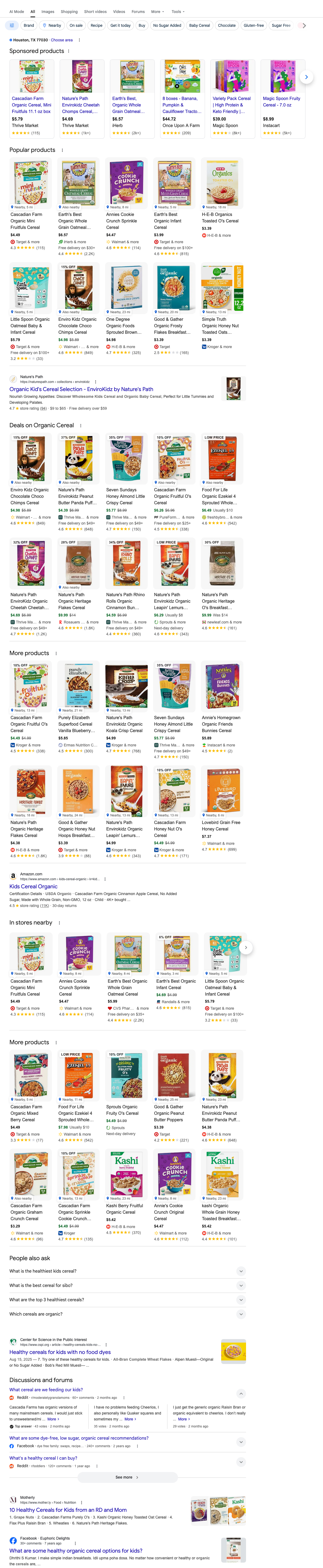 Source: Google search, “organic cereal for kids,” Houston TX market. Every circled listing is a third-party reseller; naturespath.com appears once as a single blue link, never as a merchant.
Every product image tile in that SERP is pulled from a Google Merchant Center feed. Naturespath.com does not have (or does not currently operate) a Merchant Center account connected to Shopify, so there is no feed to draw from. All the Merchant Listing schema work elsewhere in this audit makes products eligible — but eligibility without a feed is invisible. This is the foundational setup that unlocks every downstream Shopping effort.
Merchant Center Setup — current state, roadmap, feed requirements, relationship to schema work
Current state vs. required state
| Component | Current | Required for visibility |
|---|---|---|
| Google Merchant Center account | Not confirmed / not connected | Claimed, verified, owned by NP |
| Shopify → MCC product feed | No feed submitted | Automated sync via Google & YouTube Shopify app |
| Website ownership verification | Not linked to MCC | Verified in MCC via DNS record or Google Tag |
| Shipping configuration in MCC | Absent | Match Shopify’s actual shipping zones + rates |
| Tax configuration in MCC | Absent | US + CA tax rules mapped per state / province |
| Free product listings opt-in | Not active | Toggled on under MCC → Growth → Free listings |
| Product Listing schema | Partially deployed (7 / 15 fields) | Already in-progress — see schema checklist. Eligibility layer on top of feed. |
| GTINs in Shopify metafields | Partially — dual-GTIN mismatch risk | Single-unit retail GTINs + multi-pack GTINs aligned across schema + feed |
| Google Ads linkage | Not required for free listings | Optional now, prerequisite for paid Shopping / Performance Max later |
Setup roadmap (sequence matters)
- Step 1 — Audit existing state. Confirm whether NP already has an MCC account (under which email / domain). If one exists but is unused, claim access; if none exists, create a new account.
- Step 2 — Install the “Google & YouTube” Shopify sales channel app. Free Shopify-native integration that handles feed generation + automated product sync. Replaces the deprecated Google Shopping app.
- Step 3 — Verify and claim naturespath.com in MCC. DNS TXT record or Google Tag approach. Required before any feed data can process.
- Step 4 — Configure shipping + tax in MCC. Must match what Shopify actually charges. Shipping destinations for US + CA (+ en-GB, es-MX, en-MX if those markets are in-scope for Shopping).
- Step 5 — Submit initial feed + resolve disapprovals. Expect title-length warnings, GTIN formatting issues, image background rejections, and missing fields. MCC surfaces each error with a per-product diagnosis.
- Step 6 — Opt into free product listings. MCC → Growth → Manage programs → Free listings + Shopping tab. This is the free-of-cost path to the carousels captured in the screenshot above.
- Step 7 — Monitor + iterate weekly. Feed disapprovals accumulate as Shopify product data changes. Automated rules in MCC can truncate titles, fill missing fields from metafields, and rescue disapprovals before they silently remove products from the feed.
Feed quality requirements that will surface as disapprovals
These are the MCC-specific requirements that go beyond what the Merchant Listing schema already asks for. The schema fields alone don’t prevent disapprovals — the feed must also comply with MCC’s own validation.
- Title ≤150 chars, ideally 70–80. NP titles like “EnviroKidz Organic Peanut Butter Panda Puffs Cereal” are fine — titles that bake in pack size (“6×23oz”) often get truncated in Shopping display
- Description ≤5,000 chars, 500+ optimal. Currently NP product descriptions average 28 words — the same problem flagged in the content audit surfaces again here
- Image white background, 800×800+, no watermarks, no promotional overlays. MCC rejects Shopify hero images that have “NEW!” or pricing banners overlaid
- Google product category mapped to Google’s taxonomy (
Food, Beverages & Tobacco > Food Items > Grains, Rice & Cereal > Breakfast Cerealetc.). Can be auto-populated from Shopify product type if product types are clean - GTIN required for every product — can be multi-pack GTIN or single-unit GTIN depending on what the retail package carries. Must match the actual barcode
- Brand must resolve to the canonical brand name (“Nature’s Path,” “EnviroKidz,” etc.) — this connects to the schema brand-name canonical fix
- Availability must match Shopify’s actual stock (
in stock/out of stock/preorder) - Price + sale price + price valid until must match live prices on the site exactly — mismatches trigger “price and landing page mismatch” disapproval
What’s unlocked once this is set up
Every carousel in the screenshot above — Popular Products, Deals, More Products, In Stores Nearby. NP listings will compete directly with Amazon and Target’s listings for the same SKUs. Landing page: naturespath.com. Conversion tracking via GA4 ecommerce events.
Standard Shopping campaigns by category + Performance Max for automated cross-channel. All foundation work (feed, MCC account, shipping config, tracking) is shared with free listings — paid becomes a toggle when budget + strategy greenlights it. If Deep Blue runs the broader PPC account, this audit’s Merchant Center setup is the prerequisite that turns the campaign on day one.
hasMerchantReturnPolicy, shippingDetails, priceValidUntil, itemCondition, aggregateRating, brand-name canonical fix) are the eligibility layer — they make NP products qualify for Shopping display. The Merchant Center setup in this section is the distribution layer — without it, eligibility doesn’t matter because no feed exists for Google to draw from. Both are required; run them in parallel.